- English
- French
- German
- Portuguese
- Spanish
- Russian
- Japanese
- Korean
- Arabic
- Greek
- German
- Turkish
- Italian
- Danish
- Romanian
- Indonesian
- Czech
- Afrikaans
- Swedish
- Polish
- Basque
- Catalan
- Esperanto
- Hindi
- Lao
- Albanian
- Amharic
- Armenian
- Azerbaijani
- Belarusian
- Bengali
- Bosnian
- Bulgarian
- Cebuano
- Chichewa
- Corsican
- Croatian
- Dutch
- Estonian
- Filipino
- Finnish
- Frisian
- Galician
- Georgian
- Gujarati
- Haitian
- Hausa
- Hawaiian
- Hebrew
- Hmong
- Hungarian
- Icelandic
- Igbo
- Javanese
- Kannada
- Kazakh
- Khmer
- Kurdish
- Kyrgyz
- Latin
- Latvian
- Lithuanian
- Luxembou..
- Macedonian
- Malagasy
- Malay
- Malayalam
- Maltese
- Maori
- Marathi
- Mongolian
- Burmese
- Nepali
- Norwegian
- Pashto
- Persian
- Punjabi
- Serbian
- Sesotho
- Sinhala
- Slovak
- Slovenian
- Somali
- Samoan
- Scots Gaelic
- Shona
- Sindhi
- Sundanese
- Swahili
- Tajik
- Tamil
- Telugu
- Thai
- Ukrainian
- Urdu
- Uzbek
- Vietnamese
- Welsh
- Xhosa
- Yiddish
- Yoruba
- Zulu
To get four-row tapered roller bearings in large quantities, you need to work with verified suppliers and reliable B2B platforms that know what the heavy-duty industry needs. Leading suppliers in China and well-known wholesalers in Europe and North America offer reasonable prices, strict quality approvals, and specs that can be changed to fit your needs. Meihao Supply Chain Company and other platforms connect buyers from around the world with top Chinese makers. This makes it easy for buyers to get high-performance bearings that meet international standards for use in mining, metallurgy, and rolling mills.
Why Global Sourcing of Four-Row Tapered Roller Bearings Matters?
Heavy industry works all the time. Metal mills are always running, mine crushers break down tons of ore every day, and farm equipment never stops during harvest times. A key part of this never-ending productivity is the bearing system that keeps huge pieces of moving equipment running smoothly.
Getting heavy-duty bearing systems from the right source has an effect on your whole business. When it comes to production downtime, upkeep funds, and machine lifespan, quality has a direct effect. A single broken bearing in a rolling mill can stop work for hours, which means the company loses tens of thousands of dollars in income. When you work with the right provider, you get regular performance, known prices, and technical help when problems come up.
When you go global, you can find specialized manufacturers with decades of experience working with metals, advanced heat treatment tools, and strict quality control systems. China has become a manufacturing giant when it comes to making accurate bearings. This is because they have put a lot of money into getting technology from European and Japanese-bearing leaders. This gives buyers a chance to get world-class tech at a price that is low price while still meeting strict quality standards.
The hard part is making sure that suppliers are trustworthy, that technical requirements are met, and that solid supply lines are set up. OEMs in the auto industry want ISO/TS 16949 approval. Manufacturers of construction equipment need a lot of paperwork about load tests. Agricultural equipment sellers need to be sure that their supply plans will work with the production processes of the seasons. Different industries have different needs that general wholesalers often can't meet completely.
Understanding Four-Row Tapered Roller Bearings: Design and Performance
What Makes Four-Row Designs Different?
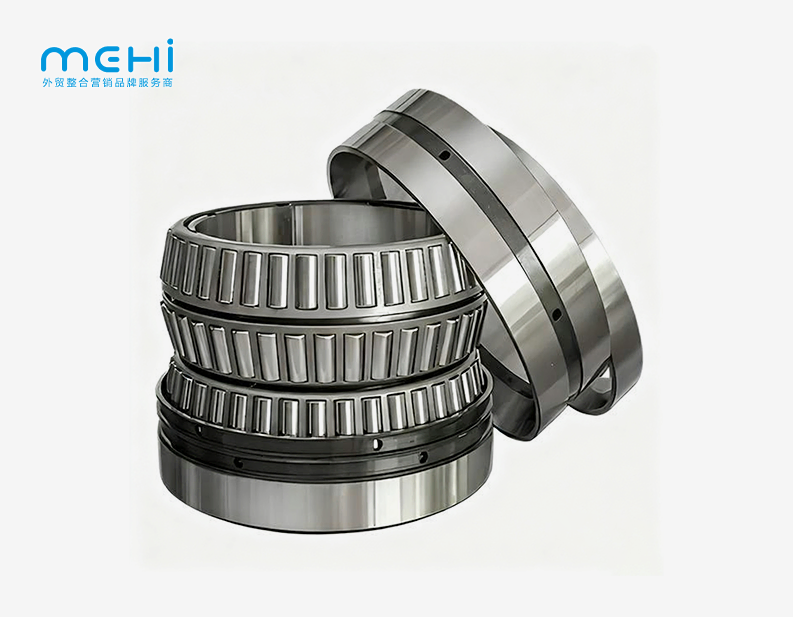
A four-row tapered roller bearing is a complex piece of engineering made for harsh environments. In contrast to single or double row designs, this one has four separate rows of curved rollers built into a small package. Each row takes on a certain amount of the total load, which spreads the stress over many touch points. In addition to being able to handle large linear loads in both directions, this design can handle three times as many rotational loads as single-row options.
The curved shape naturally makes a wedge effect when it is used. As the load increases, the rollers press more strongly against the raceways. This makes the load more evenly distributed instead of concentrating stress. This ability to straighten itself out is very useful in situations where the shaft bends under heavy loads, like in rolling mill work rolls, where steel strips cause huge bending forces.
Bore sizes usually fall between 120mm and 1320mm, which means they can fit everything from medium-sized engine shafts to huge rolling mill units. Choosing the right materials depends on how tough the environment is. GCr15 bearing steel gives basic performance, GCr15SiMn adds silicon-manganese for better hardenability, and G20Cr2Ni4A alloy steel is tougher for uses that are shock-loaded.
Technical Advantages That Drive Adoption
The main reason for selecting these bearings is to increase their load capacity. In hot strip mills, steel moves through the gaps between the rolls at speeds of up to 20 meters per second, putting more than 1500 MPa of pressure on the work rolls. In these kinds of situations, standard bearing designs would quickly wear out their surfaces. The four-row design spreads this huge force over a bigger contact area, which makes the bearing last from months to years.
Better longevity comes from more complex cage designs and built-in closing systems. When the machine is running at a high speed, centrifugal forces push against the steel bars that hold the wheels in place. Pin-type cages are used for bigger systems where the weight and size of the rollers need stronger ways to hold them in place. On both sides of the radial shaft, integral seals keep out mill scale, cooling water, and metal bits that could damage the bearing surfaces if they got in.
Less friction has a direct effect on how much energy is used and how much heat is produced. Each percentage point of less friction in the drive system of a rolling mill saves a lot of electricity over the course of a year. When compared to spherical rollers, the four-row tapered roller bearing's curved contact shape reduces rolling friction. Precise production ensures the best roller-to-raceway contact patterns that lower parasitic energy losses.
Industry Applications Where Performance Matters
The most difficult job is done by the steel rolling mill work rolls. During hot rolling, steel heated above 1000°C comes into contact with work rolls, which are sprayed with cool water to cool them down. Extreme rounds of expansion and contraction are made by this heat cycling. The bearing has to be able to handle temperature growth while staying in the exact same place so that the thickness of the strip can be controlled to within micrometers. A gap between the bearing and the roll neck lets the rolls be changed quickly, which is very important because mills lose money every minute they're not running.
In plate mills, backup rolls use even bigger bearing sets, which often have a bore width of more than one meter. These bearings keep the work roll from deflecting when rolling forces of up to a thousand tons are applied. Load distribution is very important; uneven loads would cause the track to crack and fail catastrophically before it should. Even though there are a lot of forces at work, the four-row design automatically spreads the loads evenly across the width of the bearing.
Heavy-duty mine crushers put shock loads on bearings that are spread out and go in many directions. In contrast to rolling mills, where forces are more or less predictable, crusher main shafts experience random contact events because rock breaks in unpredictable ways. Vibration resistance and impact power are what decide how long a bearing will last. The curved roller shape is better at absorbing pressure than ball bearings, and the four-row design offers redundancy—damage to one row doesn't instantly cause the whole bearing to fail.
Global Supply and Demand Dynamics
Manufacturing Concentration and Capacity
China dominates global production capacity for industrial bearings, accounting for approximately 45% of worldwide output. Provinces like Shandong, Zhejiang, and Jiangsu host clusters of specialized manufacturers with integrated capabilities from steel forging through final grinding and assembly. This geographic concentration creates economies of scale that reduce per-unit costs while fostering a competitive environment that drives continuous quality improvement.
European manufacturers maintain technological leadership in ultra-precision applications and custom engineering solutions. German and Swedish bearing makers pioneered many design innovations now widely adopted across the industry. Their facilities focus on high-value, low-volume production where engineering expertise commands premium pricing. Quality assurance managers often specify European brands for critical applications despite higher costs, valuing the extensive testing data and technical support these suppliers provide.
North American production serves domestic heavy industry with an emphasis on rapid delivery and localized technical service. Automotive Tier 1 suppliers particularly value proximity to engineering teams during new model development. The ability to conduct on-site failure analysis and iterate designs quickly justifies the higher landed costs compared to imported alternatives.
Demand Patterns Across Customer Segments
Automotive OEMs exhibit highly seasonal demand patterns tied to model year production cycles. Purchasing managers negotiate annual contracts with firm volume commitments and price schedules, then release orders against these contracts as assembly schedules firm up. Quality requirements are non-negotiable: PPAP documentation, dimensional certifications, and material traceability represent baseline expectations. Performance consistency matters more than absolute cost; bearing dimensional variation directly impacts vehicle NVH characteristics and warranty costs.
Construction machinery manufacturers face cyclical demand tied to infrastructure investment and commodity prices. When steel and copper prices rise, mining activity increases, driving demand for replacement bearings in mining equipment. Government infrastructure programs create demand spikes for construction equipment bearings. Procurement managers in this segment balance cost pressures against the reputational risk of field failures. They increasingly source from qualified Chinese manufacturers who can demonstrate ISO 9001 certification and provide third-party material test reports.
Agricultural machinery manufacturers experience sharp seasonal peaks aligned with planting and harvest seasons in major farming regions. Equipment must be ready when farmers need it; late deliveries disrupt this critical timing. These buyers value suppliers with inventory stocking programs and flexible delivery schedules. Lifecycle cost calculations weigh heavily in purchasing decisions—farmers track maintenance expenses closely, so bearings that extend service intervals command market share despite higher initial prices.
Industrial transmission system suppliers serve diverse end markets from wind turbines to marine propulsion, including four-row tapered roller bearings. Their procurement strategies emphasize technical collaboration; they need bearing suppliers who can analyze specific load cases and recommend optimal configurations. Engineering support during the design phase creates sticky customer relationships that transcend simple price competition.
Practical Supplier Verification and Procurement Guidance
Essential Qualification Steps
Verification of material approval is the basis of quality assurance. Ask for approved mill test records for bearing steel that show what chemicals are in it and how strong it is. Reliable makers keep track of their products all the way from the steel mill to the finished product. This makes it possible to connect heat numbers to serial numbers on finished bearings. Check the material meets the requirements by comparing the numbers given to foreign standards such as ASTM A295 or GB/T 18254.
Dimensional analysis shows how well the product was made. Ask possible providers to give you capacity studies (Cpk values) for important measurements such as the inner diameter, the outer diameter, and the width limits. Values above 1.33 mean that the process is statistically under control and there is a very low chance of defects. Ask for inspection results from a coordinate measuring machine (CMM) for sample bearings to make sure that the accuracy of the dimensions meets the design limits.
Controlling the heat treatment method has a direct effect on the life of the bearing. When done right, through-hardening makes the tough, shock-resistant core and the hard, wear-resistant surface that heavy-duty uses need. Suppliers should show proof of heat treatment cycles with time-temperature patterns that are confirmed by hardness tests done across the cross-sections of the raceway. Raceways with Rockwell C hardness numbers between 58 and 64 have been processed correctly.
Verifying the load rate keeps speed problems from happening. ISO 281 sets out how to figure out grades for both dynamic and steady loads. These grades come from reputable makers and are based on the real bearing shape and material qualities. Be wary of sellers who say their rates are much higher than those of similar bearings from well-known names. This could just mean that the calculations were too hopeful, not that the design is better.
Navigating Commercial Terms
Minimum order quantities vary considerably across suppliers and bearing sizes. Common diameter ranges (200-400mm bore) from Chinese manufacturers typically require 20-50 pieces minimum per specification. Larger assemblies exceeding 800mm bore may have MOQs as low as 4-8 pieces due to their specialized nature and higher unit values. Trading companies often consolidate orders to meet factory MOQs, enabling smaller buyers to access factory pricing.
Payment terms reflect the trust level in buyer-supplier relationships. New customers typically face 30-50% deposit requirements with the balance due before shipment. Established buyers with documented payment history negotiate NET 30 or NET 60 terms. Letter of credit arrangements provide security for both parties on large transactions, though bank fees add 0.5-1.5% to transaction costs.
Delivery timelines depend on whether items are stock products or custom-manufactured. Standard configurations from inventory ship within 7-14 days. Made-to-order bearings require 6-8 weeks for production plus shipping time. Complex assemblies with integral seals and special materials may extend to 10-12 weeks. Factor in shipping transit—ocean freight from China to North America averages 25-35 days port-to-port, plus inland transportation on both ends.
Quality Control Checkpoints
Pre-shipment inspection serves as the final verification before the product leaves the factory. Third-party inspection services like SGS or Bureau Veritas provide an unbiased assessment of product conformity to purchase orders. Inspection protocols should cover dimensional verification, visual examination for surface defects, material certification review, and packaging adequacy. The modest cost of inspection (typically $300-500) provides insurance against receiving a nonconforming product.
Acceptance testing upon receipt validates that the bearings survived transportation without damage. Immediately inspect packaging for damage or moisture intrusion. Randomly sample bearings for dimensional spot checks. Rotate bearings by hand, feeling for roughness or abnormal drag. Preserve all packaging and documentation pending installation and operational verification.
Four-Row Tapered Roller Bearing Performance monitoring during early operation identifies issues before they cascade into failures. Track operating temperatures, vibration levels, and noise characteristics during the first weeks of operation. Deviation from expected parameters may indicate improper installation, inadequate lubrication, or product quality issues. Early detection allows corrective action before catastrophic failure damages surrounding equipment.
Conclusion
Sourcing quality four-row tapered roller bearings for bulk orders demands careful supplier selection, rigorous verification, and clear understanding of application requirements. Direct factory relationships offer cost advantages for high-volume buyers, while authorized distributors provide valuable support for complex applications. B2B platforms bridge the gap, connecting qualified manufacturers with buyers seeking competitive pricing and assured quality. Success requires balancing technical specifications, commercial terms, and risk management through documented quality systems and performance validation. The investment in thorough supplier qualification pays dividends through reduced downtime, extended equipment life, and predictable maintenance costs.
FAQ
1. What bore size ranges are available for four-row tapered roller bearings?
Standard production ranges from 120 mm to 1320 mm inner diameter. Smaller sizes serve gearbox and axle applications, mid-range dimensions fit construction equipment drivetrains, while the largest assemblies support rolling mill work rolls. Custom sizes beyond these ranges require special manufacturing arrangements with extended lead times.
2. How do I verify material quality in imported bearings?
Request certified mill test reports showing chemical composition and mechanical properties traceable to specific heat numbers. Compare reported values against international standards like ASTM A295. Conduct hardness testing on received products and consider third-party metallurgical analysis for critical applications where material integrity directly impacts safety.
3. What certifications should suppliers provide?
ISO 9001 quality management certification represents baseline competence. Automotive suppliers require ISO/TS 16949 or IATF 16949. European markets often demand ISO 14001 environmental certification. Product-specific certifications include material test reports, dimensional inspection records, and load rating calculations per ISO 281 methodology.
4. What payment terms are typical for bulk orders?
Initial orders typically require a 30-50% deposit with the balance before shipment. Established buyers with payment history negotiate NET 30 to NET 60 terms. Letters of credit provide security for large transactions. Some platforms offer escrow services, holding payment until the buyer confirms receipt and acceptance.
Partner with Meihao for Reliable Four-Row Tapered Roller Bearing Sourcing
Meihao Supply Chain Company specializes in connecting global buyers with verified Chinese bearing manufacturers who meet rigorous quality standards, including Four Row Tapered Roller Bearing. As a Google Premier Partner for 2023-2024 and recipient of the 2024 Top Google Partner award in Greater China, we maintain an elite network of suppliers serving automotive OEMs, construction machinery manufacturers, and industrial transmission system providers. Our platform streamlines supplier verification, provides transparent pricing comparisons, and ensures compliance with international certifications. Connect with premium four-row tapered roller bearing suppliers through our platform and discover how strategic sourcing reduces costs without compromising performance. Contact our team at somyshare@gmail.com to discuss your specific requirements and receive qualified supplier recommendations within 24 hours.
References
1. Bearing Technology Institute. Heavy-Duty Bearing Applications in Steel Rolling Mills. Industrial Press, 2021.
2. Harris, Tedric A., and Michael N. Kotzalas. Rolling Bearing Analysis: Essential Concepts of Bearing Technology. 5th ed., CRC Press, 2020.
3. International Organization for Standardization. ISO 281: Rolling Bearings - Dynamic Load Ratings and Rating Life. ISO Standards Catalogue, 2019.
4. Machinery's Handbook Editorial Staff. Machinery's Handbook: Guide to Bearing Selection and Application. 31st ed., Industrial Press, 2022.
5. Neale, Michael J. The Tribology Handbook: Bearing Design and Lubrication. 2nd ed., Butterworth-Heinemann, 2018.
6. SKF Group Technical Development. Rolling Bearings in Industrial Applications: Design and Performance Optimization. SKF Global Publishing, 2023.