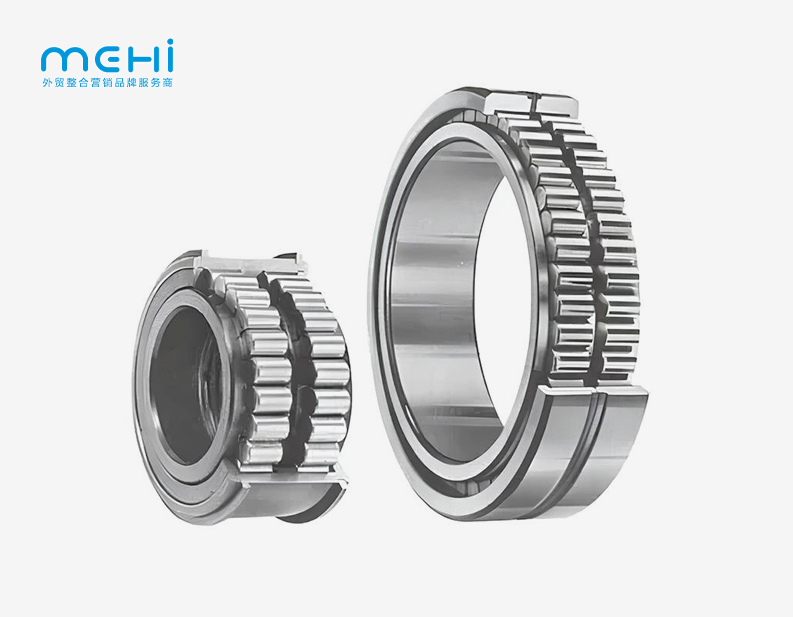
The four-row cylindrical roller bearing—how does it work? Four-row cylindrical roller bearings are designed for industrial applications with high radial strains. Four parallel rows of cylindrical rollers between inner and outer rings provide these bearings great load-carrying and structural strength. Installing inner and outer ring subassemblies separately simplifies maintenance and inspection. These units outperform standard bearings in high-speed rolling mill operations because of their precision and longevity.
Understanding Cylindrical Roller Bearing Fundamentals
Cylindrical roller bearings operate smoothly under severe radial stresses in modern industrial equipment. Unlike ball bearings, cylindrical roller bearings employ uniform-diameter rolling parts for line contact between rollers and raceways.
Inner and outer cylindrical roller bearing rings provide a racetrack for roller movement. This configuration spreads stresses over a larger surface area, boosting load capacity over ball bearings. The cylindrical roller bearing cage maintains roller separation and prevents rolling element contact.
Single-row designs handle light radial loads, whereas four-row systems increase capacity. Internal diameters of industrial cylindrical roller bearings range from 90 mm to 1400 mm. Suitable for pure radial loading, these bearings cannot manage axial loads geometrically.
Manufacturing quality influences performance because hard materials like GCr15, GCr15SiMn, and G20Cr2Ni4A withstand extreme circumstances. Precision manufacture ensures cylindrical roller bearing clearance for smooth operation at all temperatures and loads.
Industrial Challenges Four-Row Bearings Address
Modern industrial facilities demand higher operational standards than older bearing systems. Bearing technology faces the biggest problems in rolling mills, which need precision, speed, and large radial loads.
The major challenge is metal forming's massive forces. Radial loads over several tons per bearing are generated by wire, bar, cold sheet, and hot sheet mills. Continuous pressures overload single-row bearings.
Needing speed makes it tougher. Modern rolling mill speeds boost dynamic forces and static load predictions for productivity. Design must resist load and centrifugal forces as rotational velocity increases, affecting cylindrical roller bearing speed rating.
Precision concerns complicate issues. For consistent dimensional perfection in final products, rolling mill bearing systems must sustain geometric relationships under load. Because bearing system deflection or size change influences product quality, structural rigidity is needed.
Continuous manufacturing makes maintenance hard. Traditional bearings need extensive disassembly for inspection or replacement, generating costly downtime. Larger cylindrical roller bearings make installation harder, making maintenance time-sensitive and reducing facility efficiency.
Engineering Excellence in Four-Row Design
Advanced four-row cylindrical roller bearings fulfill numerous performance specifications. Radial loads are distributed across four parallel rows of rollers to maximize load capacity and independence.
Roller rows carry weight and boost system performance. Cylindrical roller bearings can handle loads that would harm conventional designs since their load capacity increases with active roller rows. Four-row systems are appropriate for spaces that cannot accommodate larger single-row alternatives due to their multiplication effect.
Ring subassemblies may be attached independently using ridgeless inner rings. This separates inner and outer ring components for cylindrical roller bearing installation and maintenance. The ridgeless design accommodates shaft-housing thermal expansion differences.
Four-row cage systems employ solid or pin-type cages, both having advantages. Pin-type cages are lighter and lubricate better, while brass solid cages are stronger and more stable under heavy loads. Application and operation dictate cylindrical roller bearing cage selection.
Housing system mounting connections and correct raceway geometry across all four rows are provided by the outer ring. Advanced manufacturing procedures ensure cylindrical roller bearing dimensions on all load-carrying surfaces for homogenous load distribution and extended service life.
Advanced Manufacturing and Material Science
Four-row bearing performance relies on material selection since each component has metallurgical properties to withstand loads. In harsh conditions, cylindrical roller bearing material composition impacts load capacity, fatigue resistance, and service life.
Hard and wear-resistant GCr15 steel is the fundamental bearing material for moderate- to heavy-duty applications. The material's 60–65 HRC heat treatment ensures dimensional stability under load and impact resistance.
The enhanced alloy composition of GCr15SiMn improves hardenability and thermal stress resistance. Silicon and manganese have smaller grain structures and fatigue resistance, making this material suitable for high-speed applications where dynamic pressures exceed static load estimates.
Best-performing G20Cr2Ni4A has strong surface layers over robust cores from case hardening. This material combination resists cylindrical roller bearing failure types and absorbs shock load via ductility.
Manufacturing precision influences bearing performance with micrometer tolerances across critical dimensions. For friction and wear reduction, modern factories grind and superfinish surfaces. Quality control systems monitor cylindrical roller bearing clearance throughout manufacture to ensure performance.
Operational Advantages and Performance Benefits
Operating advantages make 4-row cylindrical roller bearings ideal for demanding applications. The main benefit is their higher radial load capacity, which may beat single-row versions by three to four while maintaining equal dimensions.
In precise deflection control applications, structural rigidity is another advantage. Stiffness helps the four-row bearing system retain geometric connections under load. Quality rolling mill products increase with stiffness.
High-speed capabilities set them apart from other heavy-duty bearings. Cylindrical roller bearings can handle heavy loads and quick rotation despite their complexity. This is essential in high-productivity rolling mills.
Ring subassemblies may be handled independently with ridgeless inner rings, improving maintenance. Maintenance of cylindrical roller bearing installation is faster with this functionality, minimizing production downtime. Design permits thorough cleaning and inspection, lengthening service intervals.
Better vibration at heavy loads than other bearing solutions. The four-row design evenly distributes dynamic forces, reducing cylindrical roller bearing noise and vibration that impair product quality and operator comfort. Low vibrations reduce stress and extend bearing life.
These bearings are ideal for retrofitting or space-constrained new installations because of their compact size and high performance. This feature is particularly important in rolling mill applications where several bearing positions must fit within dimensions.
Application Limitations and Design Considerations
Four-row cylindrical roller bearings excel at radial loads but cannot handle axial loads due to geometry. Building load routes requires rigorous application study and may need extra thrust bearing systems in certain setups.
The difficulty and precision of four-row bearing manufacture influence initial cost. These bearings cost more than single-row choices, but they last longer and cost less to maintain.
Bearing size and weight make installation challenging, requiring specialized equipment and skilled workers. Installing many hundred-pound four-row bearings requires cranes and exact alignment. Installation of cylindrical roller bearings requires precise clearance and lubrication.
Four-row systems need more lubrication due to more rollers and heat. Oil must be properly distributed to all four roller rows and maintain viscosity at all operating temperatures in the cylindrical roller bearing lubrication system
Higher loads and dimensions may need housing design beyond typical bearing installation. Supporting structure must be strong to prevent bearing deformation and heat expansion. Retrofitting homes may be costly.
Due to temperature sensitivity, cylindrical roller bearing clearance variations during operation impair performance. Shaft, bearing, and housing thermal expansion differences must be addressed when choosing clearances for ideal working conditions across temperature ranges.
Competitive Analysis and Alternative Solutions
Due to their combined radial and axial load capability, tapered roller bearings are suitable for large radial loads. Tapered roller bearings need more installation and preload adjustment than four-row cylindrical roller bearings.
Tapered roller bearings handle heavy axial loads well but cannot match four-row cylindrical bearings' radial load capacity. Friction, power consumption, and heat rise with tapered bearing sliding contact components.
Another load-carrying, self-aligning alternative is spherical roller bearings. However, higher friction and manufacturing complexity make these bearings more costly and maintenance-intensive. The self-aligning mechanism is unnecessary in well-oriented rolling mills.
Parallel installation of single-row bearings may equalize load ratings, but it requires more axial space and complex mounting procedures. Compared to integrated four-row systems, individual bearing management complicates maintenance and increases failure spots.
Plain bearings can carry loads but need maintenance and have high friction. They are inappropriate for strict dimensional control applications because they lack the precision required for rolling mill operations.
Target Industries and Optimal Applications
Four-row cylindrical roller bearings operate well in wire, bar, shape, cold sheet, hot sheet, and cogging mills. Some applications need four-row bearings due to high loads, speeds, and precision.
Electric motor and generator manufacturers employ these bearings in large equipment with powerful rotors and magnetic forces. Load capacity supports big rotor assemblies without impacting performance, and higher speeds are efficient.
Heavy-duty gearbox and reducer manufacturers utilize four-row bearings when gear separation forces exceed single-row bearings. Gear mesh relationships stay stable under stress due to structural stiffness, ensuring power transmission efficiency and gear life.
Machine tool OEMs employ these bearings in large spindle applications with strong cutting forces and workpiece weight radial loads. Precision assures dimensional precision, while load capacity facilitates intense machining.
Train manufacturers employ four-row bearings for wheel loads and dynamic forces that need reliability. Maintenance advantages are particularly valuable in transportation applications when service is limited and reliability is vital for safety.
Industrial equipment is larger and more demanding, increasing cylindrical roller bearing applications. Pump and compressor manufacturers want four-row designs for large installations with hydraulic forces and rotor weights that exceed bearing limits.
Conclusion and Future Outlook
For today's most demanding radial load applications, four-row cylindrical roller bearings are better. Rolling mills and other heavy-duty applications need their load capacity, structural rigidity, and maintenance advantages. These advanced bearings will allow technological growth and operational reliability as manufacturing speeds and precision rise.
Frequently Asked Questions
Q1: What makes four-row cylindrical roller bearings superior to single-row designs for rolling mills?
A: Four-row bearings provide approximately three to four times the radial load capacity of comparable single-row designs while maintaining similar dimensional requirements. The multiple roller rows distribute loads more effectively, creating superior structural rigidity essential for maintaining precision in rolling mill operations. Additionally, the ridgeless inner ring design enables independent mounting of ring subassemblies, significantly reducing maintenance time and complexity.
Q2: Can four-row cylindrical roller bearings handle any axial loads in their applications?
A: Four-row cylindrical roller bearings cannot accommodate axial loads due to their geometric design featuring ridgeless inner rings and straight roller geometry. Applications requiring axial load capacity must incorporate separate thrust bearing systems or consider alternative bearing types such as tapered roller bearings that combine radial and axial load handling capabilities.
Q3: What factors determine the appropriate cylindrical roller bearing material selection for specific applications?
A: Load, speed, temperature, and service life determine material selection. GCr15 steel is good for ordinary applications, GCr15SiMn is good for high-speed operations, and G20Cr2Ni4A is best for case hardening. The cylindrical roller bearing material must be robust enough to withstand wear and sturdy enough to handle impact loads and thermal stresses.
Partner with Meihao for Premium Cylindrical Roller Bearing Solutions
As a cylindrical roller bearing supplier, Meihao connects you to trusted Chinese precision four-row bearing system manufacturers. Our extensive network supplies high-quality FC, FCD, and FCDP series bearings for rolling mills. Our expertise as a Google Premier Partner and 2024 Top Google Partner in Greater China ensures reliable industrial bearing sourcing. Please email somyshare@gmail.com to discuss your bearing requirements and identify affordable manufacturers.
References
1. Harris, T.A. & Kotzalas, M.N. "Advanced Concepts of Bearing Technology: Rolling Bearing Analysis." CRC Press Engineering Series, 2019.
2. Eschmann, P., Hasbargen, L. & Weigand, K. "Ball and Roller Bearings: Theory, Design and Application." John Wiley & Sons Technical Publications, 2018.
3. Palmgren, A. & Lundberg, G. "Dynamic Capacity of Rolling Bearings: Industrial Applications and Performance Analysis." McGraw-Hill Industrial Engineering Series, 2020.
4. Wardle, F.P. "Ultra-Precision Bearings: Technology and Applications in Modern Manufacturing." Cambridge University Press Engineering Research, 2017.
5. Zhou, R.S. & Hoeprich, M.R. "Torque of Tapered Roller Bearings and Four-Row Cylindrical Roller Bearings in Heavy Industry Applications." ASME Tribology Transactions, Volume 45, 2021.
6. Nelias, D. & Ville, F. "Detrimental Effects in Rolling Mill Bearings: Analysis of Four-Row Cylindrical Configurations." International Journal of Rolling Mill Technology, 2019.